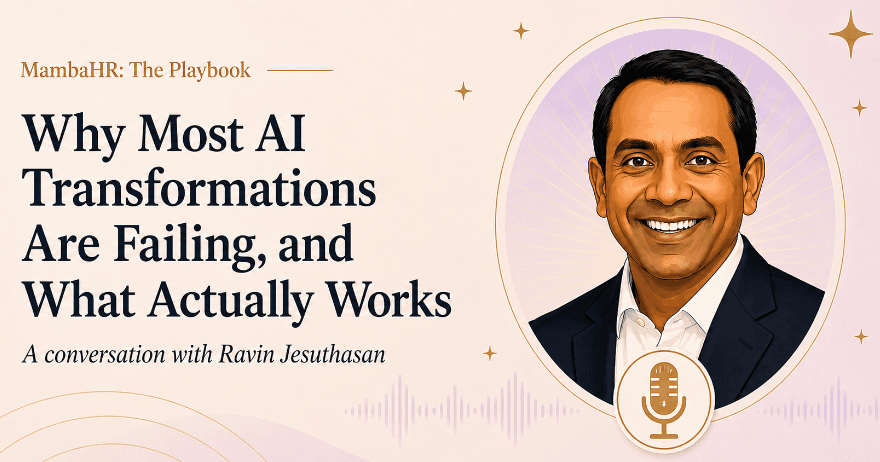
Watch the full conversation with Ravin Jesuthasan on MambaHR: The Playbook.
I just finished recording what might be the most important conversation I've had about AI and the future of work. My guest was Ravin Jesuthasan, CFA, FRSA, who leads Mercer's global transformation practice and has advised over 1,000 organizations on redesigning work for the AI age.
When I asked ChatGPT to identify the top voices on AI and work transformation, Ravin came up number one. After our conversation, I understand why.
The Problem Nobody's Talking About
Two years after ChatGPT launched, something interesting happened at Davos. Ravin was in conversations with groups of CEOs and CHROs, and when he asked about their AI returns, the room got quiet. Despite massive investments in AI tools, very few organizations have seen meaningful results.
This isn't a technology problem. It's an approach problem.
Most companies are doing what Ravin calls "democratizing access to technology" - buying AI tools, giving everyone access, and hoping something good happens. It's the same spray-and-pray approach that's never worked with any technology, but we keep doing it because it feels like progress.
The companies that are actually winning take a completely different approach. And the results speak for themselves: about 40-50% improvements in capacity and 30% improvements in profitability.
The Framework That Changes Everything
Ravin shared a framework based on research from 135 case studies his team analyzed. The core insight is simple but profound: you have to start with the work, not the technology.
This means understanding exactly how AI impacts different types of work - where it replaces human tasks, where it enhances human capability, and where it creates entirely new opportunities. But here's the key: you can't figure this out at the job level. You have to go deeper.
"AI doesn't replace entire jobs," Ravin explained. "It replaces and augments and transforms parts of jobs."
Unless you deconstruct work into its component activities and skills, you'll never optimize the human-AI combination.
I've experienced this firsthand in my own work. When I started using AI for research and content creation, I didn't just replace my old process. I completely redesigned how I approach these tasks. The AI handles certain parts, but I bring something else entirely. The combination is exponentially more powerful than either could be alone.
From Fear to Competitive Advantage
One of the most fascinating parts of our conversation was about what Ravin calls FOBO: Fear of Becoming Obsolete. It's real, it's widespread, and it's paralyzing organizations that should be moving forward aggressively.
But Ravin's research shows something counterintuitive: the solution isn't to minimize the fear. It's to completely redesign your relationship with your workforce.
The organizations that are winning have made a fundamental shift in their value proposition. Instead of promising job security, they're promising something more valuable: relevance security.
They're saying to their people, "We will keep you relevant for a changing world."
This goes way beyond traditional training programs. Ravin outlined three levels of commitment that forward-thinking organizations are making, and the third one surprised me. It's not just about helping people succeed within your organization. It's about helping them succeed even if they leave.
The Skills Revolution
Perhaps the most important insight from our conversation was about moving from job-based to skills-based thinking. This isn't just HR buzzword territory - it's a fundamental shift that determines whether your organization thrives or struggles in an AI-powered world.
Ravin outlined three different models for how people can connect to work in the future, and most organizations need all three. The question isn't which one to choose. It's understanding where each model creates the most value.
When you think in terms of skills instead of jobs, you can see exactly where AI creates value and where human capabilities become more important, not less. You can also see opportunities that are invisible when you're stuck in traditional job-based thinking.
What Individuals Need to Know
I asked Ravin what skills individuals should focus on to become future-ready. His answer was both simple and profound.
Curiosity. "You are only as good at anything as long as you're curious about it," he told me. This isn't just about learning new things. It's about maintaining the hunger to understand how your domain connects to others, looking beyond your traditional boundaries.
The second skill was learning agility. The willingness to experiment and think outside your traditional boundaries. If you're in finance, how much do you understand about technology and human resources? If you're in HR, how well do you grasp the financial and operational realities of your business?
This resonated deeply with my own journey. I started as an HR business partner, but the most valuable thing I've done is learn about marketing, sales, technology, and entrepreneurship. That broader perspective doesn't make me less of an HR professional. It makes me a more valuable one.
Ravin also talked about the evolution from T-shaped leaders, deep in one area and broad in others, to what he calls "Pi-shaped" leaders: deep in two or more domains with the ability to think laterally across many others.
Our identity can't be bound up in a single job function anymore.
The Metrics That Actually Matter
With all the AI performance data flooding organizations, I asked Ravin what leaders should actually pay attention to. His answer was refreshingly simple and focused on three key areas.
But here's what struck me: the third metric he mentioned is something most organizations aren't even thinking about, yet it might be the most important one for long-term success.
The Change Management Reality
One of the most practical insights from our conversation was about implementation. Ravin has seen a clear pattern: every organization that tries to mandate AI adoption from the top down struggles or fails.
The ones that succeed do something completely different.
The successful approach involves positioning AI adoption as something else entirely - and it requires a level of trust and collaboration that many organizations aren't used to. But when it works, it works spectacularly.
What This Means for You
Whether you're a leader trying to navigate AI transformation or an individual contributor wondering how to stay relevant, this conversation has insights you need to hear.
Ravin isn't just predicting the future. He's helping the biggest companies on the planet build it. His perspective is based on real data from real organizations going through real transformations.
The future of work isn't something that happens to us. It's something we actively create. The question is whether you'll be designing that future or just reacting to it.
Listen to my full conversation with Ravin Jesuthasan to get the complete framework, the specific skills that matter most, and the practical steps you can take starting this week.
The question for all of us is simple: are we designing the future of work, or just reacting to it?