I recently saw one of the best real world examples of AI in HR, and it did not come from a vendor demo.
It came from an old colleague who runs global payroll at a well-known tech company.
She built a script that runs locally on her machine to audit payroll. The work used to take her, a true payroll expert, about a full day. For someone less experienced, it could take two or three days and still come back with errors.
Now the script runs the audit faster, more consistently, and without sending sensitive payroll data into some random tool.
That is the AI in HR conversation in one example.
The upside is huge. The privacy risk is also huge.
And that is exactly why HR AI is moving slower than people think it should.
HR data is different
A marketing team can ask AI to clean up copy. A sales team can ask AI to summarize an account. An engineer can ask AI to explain code.
HR can use AI too, but the data is different.
HR data includes pay, performance, medical leave, accommodations, investigations, employee relations history, demographic information, candidate data, manager notes, terminations, and sometimes very personal context.
That changes the question.
The question is not just, what can AI do?
The better question is, what can we safely give AI access to?
That is where a lot of companies are right now. People have GPT, Gemini, Copilot, Claude, internal tools, external tools, scripts, spreadsheets, and a lot of confusion about what is okay to use.
Everyone can see the productivity gain. Nobody wants to be the person who accidentally uploads comp data, medical leave details, or a termination list into the wrong place.
That is not fear. That is good judgment.
But good judgment still needs a system.
What serious companies are doing
The best companies are not just saying, “Use AI.”
They are moving AI into controlled environments.
OpenAI says business data is not used to train models by default, that customers own and control their inputs and outputs where allowed by law, and that enterprise customers can control retention and connected internal sources. OpenAI also points to controls like SAML SSO, access management, encryption, SOC 2 audits, DPAs, audit logs, and retention controls.
Microsoft’s 365 Copilot is designed to work through Microsoft Graph, which means it can use emails, chats, documents, meetings, and contacts the user already has permission to access. Microsoft also states that prompts, responses, and data accessed through Graph are not used to train foundation models.
Google Workspace with Gemini takes a similar enterprise approach. Google says enterprise Gemini submissions are not used to train models and are not reviewed by humans. It also says NotebookLM sources, queries, and responses stay within the organization for eligible Workspace editions.
That tells us where this is going.
AI adoption inside HR will depend on controls like:
• Enterprise accounts
• Admin settings
• Permission inheritance
• Data retention controls
• Audit logs
• Data classification
• DLP
• Human review
• Approved use cases
• Clear rules for sensitive employee data
That is not boring compliance work. That is the unlock.
Why the patent process changed how I think about this
Going through the patent application process for my passion project/startup, MambaHR, forced us to get very specific.
Not “AI for HR” specific. That is too vague.
We had to think through the actual architecture.
What data comes in? What gets normalized? What gets suppressed? What gets anonymized? What gets routed to AI? What gets blocked? What gets logged? What can a manager see versus an HRBP versus an executive?
Our patent application describes cross-platform HR data integration, privacy-preserving analytics, and AI decision support. The system pulls from disparate enterprise sources such as HRIS platforms, communication tools, code repositories, project management systems, calendar applications, and other workplace systems, and then normalizes the data into a unified analytical framework.
My extremely brilliant CTO of MambaHR, Sebastian Kirsch, wrote a technical white paper that expands the idea into 36 enterprise data integrations and 162 behavioral signals across communication, project management, CRM, support, productivity, design, marketing, finance, and more. The point is not to spy on employees. The point is to understand how work actually happens while maintaining strict privacy controls.
That is the line HR AI has to walk.
More intelligence, but not more exposure.
Privacy cannot just be training
A lot of companies are trying to solve AI privacy with training.
“Do not paste sensitive data into ChatGPT.”
That is useful. It is also not enough.
People are busy. Work is messy. Sensitive data shows up in normal HR workflows all the time.
That is why the architecture matters.
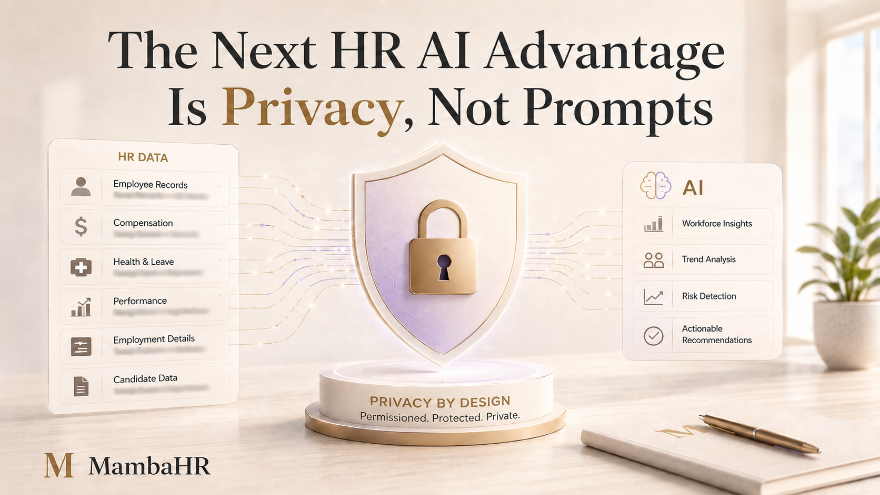
One part of our patent application describes an AI security gateway that scans user requests for personally identifiable information across multiple categories, including names, email addresses, Social Security numbers, phone numbers, physical addresses, dates of birth, financial account numbers, medical record numbers, and other sensitive identifiers. The system replaces that information with type specific tokens, then substitutes synthetic entities that maintain context before anything is transmitted to an AI model.
Plain English version: The AI can understand the structure of the request without receiving the actual person’s identity.
That is very different from trusting every employee to remember every privacy rule every time they use AI.
The practical framework for HR teams
Here is how I think HR leaders should approach this now.
1. Classify the use case before picking the tool
Do not start with “Should we use GPT or Gemini?”
Start with: What data is involved? What decision could this influence? Could this affect someone’s pay, job, promotion, leave, performance, or employment status?
That tells you the risk level.
2. Keep sensitive data in approved environments
Use enterprise tools with admin controls, retention settings, access management, DPAs, audit logs, and clear vendor terms.
Do not use consumer tools for sensitive HR work.
3. Use anonymized data where possible
HR does not always need names to get value.
You can learn a lot from patterns by function, tenure, location, level, role, manager span, and workload without exposing individual employees unnecessarily.
4. Separate analysis from decisions
AI can summarize, flag, compare, validate, draft, and route.
That does not mean AI should decide who gets hired, promoted, terminated, placed on a PIP, or included in a layoff.
For high stakes employment decisions, AI should support the process. Humans should own the decision.
5. Build the audit trail early
If AI touches HR work, the system should show what data was used, what policy applied, what recommendation was generated, who reviewed it, who approved it, what changed, and what final decision was made.
Great demo, no audit trail is not good enough for HR.
Why this matters for MambaHR
This is why MambaHR is being built for privacy and compliance first.
AI in HR cannot just be a chatbot sitting on top of employee data.
It has to understand permissions. It has to protect sensitive information. It has to suppress small group analytics when privacy thresholds are not met. It has to log what happened. It has to help HR move faster without creating a compliance mess.
That is the product philosophy.
Not “paste your HR problem into AI and good luck.”
More like: AI helps complete the workflow, protect data, check the rules, document the decision, and give HR time back.
That is the future I think HR is heading toward.
AI will absolutely change HR. But the companies that win will not be the ones moving fastest with the least control.
They will be the ones that move fast because they built the control layer first.
Question for HR leaders: where are you already seeing AI save time in HR, and what privacy guardrails are you putting around it?
Sources
OpenAI Enterprise Security & Privacy
Microsoft 365 Copilot Security & Data Protection