Last week, I attended the Cornell University CAHRS HRBP Summit hosted by Docusign. For anyone who is not familiar with CAHRS, it is one of the few places where academia and HR practitioners get in the same room and talk about what is actually happening inside companies.
That is what made it useful. This was not the polished conference version where every company pretends their strategy is perfect and their transformation roadmap came down from the mountain on stone tablets. It was the real version. HR leaders were talking about AI, headcount, early talent, org design, manager capability, support transformation, culture, governance, and the increasingly confusing question of what HR is supposed to do when the business is moving faster than our old processes can handle.
The biggest thing I took away is this: the AI conversation has moved past “does this matter?” That part is over. The harder question now is much more practical.
What do we actually do with it?
That is where a lot of companies are stuck. They have tools. They have executive pressure. They have employees experimenting. They have vendors promising magic. They have leaders asking for productivity. What they often do not have is a clear operating model for how AI should change work, how those changes should be governed, and how HR should help the business move faster without making a mess.
That is the HR AI strategy most companies are missing.
AI is turning HR into a work design function
The main throughline from the summit was that HRBPs are no longer just “supporting the business.” That phrase is starting to feel too small for where the role is going.
The HRBP role is becoming much more about helping design the operating system of the company. Talent, org structure, culture, skills, manager expectations, AI, and governance cannot sit in separate lanes anymore. They are all connected.
When leaders talk about AI productivity, HR has to ask what work is actually changing. When someone throws out a future headcount target, HR has to ask whether the number is grounded in real productivity data or just ambitious PowerPoint math. When a function says AI will absorb work, HR has to ask what happens to roles, career paths, manager expectations, employee trust, and the operating model around it.
That is the job now: help the business redesign work without losing the plot. And yes, it is more complicated than telling everyone to use Copilot and hoping the savings show up by Q4.
The summit conversations made that pretty clear. Leaders talked about ambitious AI-driven headcount goals, experiments with AI-native teams, AI-assisted performance processes, early talent as an AI-fluent pipeline, and support org redesign where AI agents may increasingly become the first line of support. The big theme was not “AI is coming.” It was, “AI is already here, and now we have to redesign the work around it.”
So what should HR leaders actually copy?
1. Start with the work, not the tool
The best companies are not starting with “Which AI tool should we buy?” They are starting with a more useful question: where is work painful, repetitive, expensive, slow, confusing, or risky?
Microsoft’s internal rollout of its Employee Self-Service Agent is a strong public example. Microsoft deployed the agent across more than 300,000 employees and vendors, and the first use cases were not limited to HR. The rollout started with human resources, IT support, and campus services, with plans to expand into areas like finance and legal.
That matters because employees do not experience companies in neat functional boxes. Nobody wakes up thinking, “Today I will have one HR issue, one IT issue, and one facilities issue.” They think, “I need help,” “I need access,” “I need to know what to do,” or “I need someone to make this problem go away.”
That is the first thing HR leaders should copy: start with real employee friction, not an HR tech category.
If the employee has to know which system to open, which team owns the issue, which policy applies, who needs to approve it, and what happens next, the company has not transformed anything. It has just moved the burden to the employee and called it self-service.
A practical starting point: pick three employee or manager moments that create the most repeated questions or follow-up work. Onboarding. Access requests. Leave questions. Internal transfers. Compensation changes. Equipment return. Manager approvals. Then map what it currently takes to get that work done from beginning to end. The point is not to “add AI.” The point is to remove unnecessary work.
2. Build the operating model around AI
The most overlooked part of Microsoft’s example is that the technology was only one piece. The rollout of its Employee Self-Service Agent required business owners, platform administrators, content owners, subject matter experts, compliance, privacy, security, support teams, and end users involved in testing and validation. Microsoft also called out governance, content quality, data security, user access, change tracking, reviewing, auditing, deployment control, rollback planning, and ongoing measurement as major considerations.
That lined up with the summit conversations. The companies taking AI seriously are not treating it like a feature launch. They are treating it like an operating model shift.
Someone has to own the source content. Someone has to decide where AI can act and where a human must approve. Someone has to define what data can be used. Someone has to explain what gets logged. Someone has to decide what happens when the AI is wrong. And someone has to make sure leaders do not confuse “fast” with “defensible.”
In many functions, a bad AI output creates rework. Annoying, but manageable. In HR, a bad AI output can create legal issues, employee relations issues, privacy issues, fairness issues, or trust issues. Much less cute.
A practical starting point: before launching any HR AI use case, assign owners for source content, approvals, escalation, data access, change management, measurement, and audit review. If no one owns those things, the tool will eventually create confusion. Or worse, confidence in something that is wrong.
3. Attack the ticket factory first
A lot of AI conversations jump too quickly to replacing jobs. That gets clicks, but it skips the work sitting right in front of us.
For many HR teams, the first measurable AI win is reducing repetitive support work. The same question answered again. The same form routed manually. The same approval chased. The same manager reminded. The same onboarding step checked. The same employee trying to figure out which portal is hiding the answer this time.
BambooHR’s work with Moveworks is a useful public example. According to Moveworks, BambooHR used AI to automate repetitive tasks, deflect tickets at the source, and support employees with 24/7 self-service. The company reported an approximately 30 percent reduction in help desk tickets, with many tier-one tasks resolved autonomously within minutes. The examples included IT requests, benefits questions, documentation access, onboarding questions, and troubleshooting.
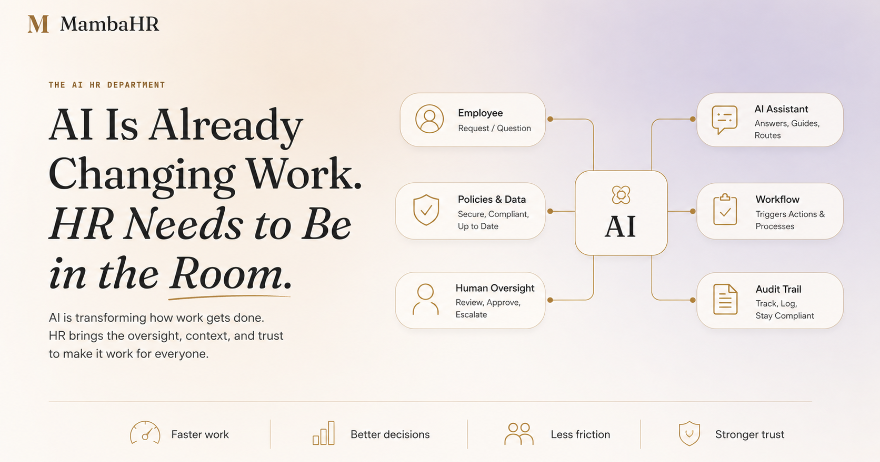
This is not the full future of HR AI, but it is a very real starting point. The old version of self-service gave employees more portals and managers more clicks. The next version has to actually complete the work. It should answer the question, route the request, trigger the workflow, generate the right document, notify the right person, track the approval, update the system, and create an audit trail.
That is the difference between a knowledge base and an execution layer.
A practical starting point: do not begin with the most controversial employment decision. Start with high-volume, lower-risk, repeatable work where the process is already known and the ROI is measurable. Look at your top HR, IT, and employee support tickets. That is probably where your first AI workflow opportunity is hiding.
4. Rethink early talent and skills
One of the most interesting summit themes was early talent. The entry-level conversation is changing fast.
On one hand, AI may reduce some of the work that historically gave junior employees their reps. On the other hand, early career talent may become one of the fastest ways to build AI fluency into the company. Several companies discussed internships, early talent pipelines, skills-based hiring, internal gigs, and AI academies as ways to build the workforce differently.
That is a big deal. If AI changes what entry-level work looks like, companies cannot keep using the same job architecture and pretend everything still makes sense. They need to think about skills, not just titles. They need to think about learning velocity, not just tenure. They need to think about who can adapt fastest, not just who has already done the job before.
A practical starting point: pick one role family and ask three questions. What work in this role is likely to be automated or assisted by AI? What skills become more valuable because of AI? What early career experiences need to change so people still build judgment, not just tool fluency?
That last part matters. We cannot accidentally create a generation of employees who are great at prompting but never learn how to think through the work.
5. Measure work changed, not headcount replaced
The public conversation around AI keeps drifting toward one question: how many people will this replace?
That question gets attention, but it is not the best way for HR leaders to run transformation. It is too blunt, too easy to sensationalize, and not operational enough for the people who actually have to redesign work inside a company.
The better question is: what work changes?
The International Labour Organization’s 2025 research gives a more useful framing. Globally, the ILO found that one in four workers are in occupations with some generative AI exposure, but only 3.3 percent of global employment falls into the highest exposure category. The ILO also notes that because most occupations still include tasks requiring human input, job transformation is the more likely impact than full job elimination.
That is exactly how HR should think about this. Not agent versus FTE. Workload versus judgment. Volume versus risk. Automation versus approval. Speed versus defensibility.
The metrics that matter should look more like hours returned to the business, tickets avoided, workflow completion time, human handoffs avoided, escalation rate, policy accuracy rate, manager tasks automated, employee questions resolved, compliance issues flagged, and employee moments completed without HR chasing people.
A practical starting point: create a simple AI transformation scorecard before you launch the use case. Track the current state first. How many tickets? How many handoffs? How long does the workflow take? How many people touch it? How often does HR have to chase someone? If you do not know the baseline, you will not be able to prove the transformation.
6. Build the audit trail before the mess
HR is different from many other functions because HR work touches employment decisions, pay, performance, accommodations, leave, terminations, investigations, and sensitive employee data. That means AI in HR has a higher bar.
New York City’s Local Law 144 is one example of where the regulatory direction is going. The law prohibits employers and employment agencies from using covered automated employment decision tools unless the tool has had a bias audit within one year, information about the audit is publicly available, and certain notices have been provided to employees or job candidates. Enforcement began July 5, 2023.
You do not have to be a lawyer to see the trend. Companies will need to explain, audit, govern, and defend how AI is used in employment-related workflows. That does not mean HR should avoid AI. It means HR should stop treating governance as something that happens after the tool is live.
For HR, governance is product design.
Every serious HR AI workflow should be able to show what source was used, what policy version applied, what recommendation was made, who reviewed it, who approved it, what changed, when it changed, why it changed, what was escalated, what was rejected, and what final decision was made by a human.
This is where a lot of tools are going to break. They will look impressive in a demo, but they will not be defensible in a real employment moment. Great demo. Terrible deposition. Not exactly the transformation story anyone wants.
A practical starting point: build the audit trail before you scale the workflow. At minimum, HR should be able to see the source used, the policy version, the recommendation, the approval path, the human decision owner, the timestamp, the escalation reason, and the final outcome.
What this means for HRBPs
The biggest shift is that HR AI transformation cannot stay inside HR. AI is going to change how work happens across sales, customer success, support, engineering, finance, legal, marketing, operations, and every manager-led team.
At the summit, support transformation came up as one of the clearest examples. Support is often where AI, org design, skills, location strategy, employee communication, and customer experience collide first. Leaders discussed future support models where AI agents increasingly handle the front line while humans focus on more complex and higher-value scenarios.
That sounds clean until you start asking the HR questions. Which roles change? Which employees can be reskilled? Which managers can lead through that transition? How do we communicate it without creating panic? How do we decide who moves into new roles? How do we measure whether the new model is actually better?
That is where the HRBP role is heading.
The HRBP of the next few years needs to be part org designer, part talent strategist, part data translator, part change leader, and part governance partner. Easy, right? Just five jobs in one. Classic HR.
A simple 30-day starter plan for HR AI transformation
If you are an HR leader trying to move from AI curiosity to real transformation, here is where I would start.
In week one, identify the top 10 employee or manager support requests across HR, IT, and operations. Do not guess. Pull ticket data, ask HR operations, ask IT, ask managers, and look for the work people keep repeating.
In week two, pick one workflow and map it from beginning to end. Capture who starts it, who owns it, which systems are involved, which policies apply, which documents are needed, which approvals are required, where the work gets stuck, and what proof is needed later.
In week three, define the AI role and the human role. AI may answer the question, summarize the policy, route the request, draft the document, or trigger the next step. A human may still need to approve, edit, escalate, decide, or communicate. Be explicit about that handoff.
In week four, define the success metrics and governance. Track time saved, tickets avoided, handoffs reduced, policy accuracy, escalation rate, employee satisfaction, manager effort, and audit completeness. Also define who owns the workflow after launch. AI workflows are not “set it and forget it.” They need owners.
That is not the full playbook. But it is a real starting point.
Final thought
A lot of people want the AI in HR playbook. I get why. HR teams are being asked to move fast while the ground is shifting under them. Employees are already using AI. Managers are experimenting. Vendors are selling hard. Executives want productivity. Legal wants control. HR is stuck in the middle trying to make it all work.
But before the playbook, we need the mindset shift.
The best companies are not just asking what AI can do. They are asking what work needs to change, what operating model is required, what governance needs to exist, what employee trust requires, and how to measure whether the new way is actually better.
That is where HR needs to lead. Based on what I heard at the summit, the companies that move fastest will not be the ones pretending this is simple. They will be the ones willing to do the hard work of redesigning work clearly, measuring what changes, and keeping the human part of the business from getting lost in the AI hype.
Question for HR leaders: where is AI already changing work in your business, and are you in the room for that conversation?
Sources
Microsoft Employee Self-Service Agent Rollout
BambooHR and Moveworks customer story