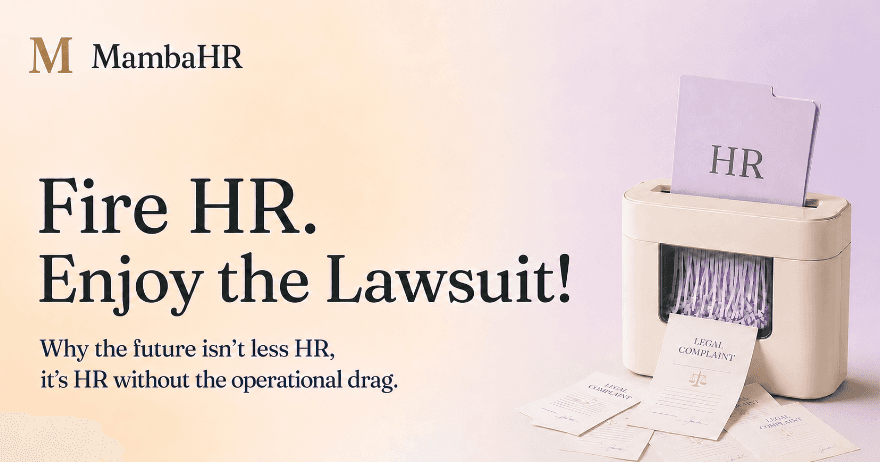
Bolt’s CEO made headlines after saying he got rid of HR because the team was “creating problems that didn’t exist,” which is the kind of sentence that makes some CEOs nod, some HR leaders panic, and every employment attorney quietly open a new folder. But underneath the drama, he was reaching for something real: less bureaucracy, more manager ownership, and faster people decisions. That part is right. The mistake is thinking the company needs less HR. The real answer is HR with the operational drag removed.
The Fortune piece about Ryan Breslow and Bolt lit up the HR world because it hit an old nerve with new packaging. Predictably, half the internet heard “finally, someone said it,” while the other half started mentally preparing the litigation hold. And honestly… both reactions make sense.
Because yes, a lot of CEOs are frustrated with HR.
A lot of managers are frustrated with HR.
A lot of employees only think about HR when something is broken, awkward, confusing, or legally spicy.
But I think the more interesting story is not whether one company should have cut HR.
The more interesting story is that HR has been preparing for this moment for nearly two decades.
The rise of the HR Business Partner model was supposed to change the function. HR was no longer meant to sit outside the business, guarding policies and processing paperwork. HR was supposed to sit inside the business. Next to leaders. Next to the work. Close enough to understand strategy, challenge decisions, coach managers, anticipate talent risk, shape org design, and connect people decisions to business outcomes.
That was the promise. And honestly… it was the right one.
The problem is not that HR lacks strategic value. The problem is that HR got buried before it could consistently deliver that value.
Most HRBPs were asked to become strategic partners while still wearing the operational backpack from hell: employee questions, manager escalations, onboarding tasks, offboarding details, compliance workflows, performance cycles, survey follow-ups, documentation, headcount spreadsheets, policy interpretation, Slack pings, and the universally terrifying message that starts with, “Quick question…”🫠
Which is never quick.
Ever.
By the time HR gets to the strategic conversation, half the day has already been eaten by work that should have been routed, automated, answered, escalated, or handled by a system. That is not an HR talent problem. That is an HR operating system problem.
And CEOs and CHROs should care because this is no longer just an HR efficiency issue. It is a business speed issue.
McKinsey’s 2025 State of AI research shows the broader enterprise problem clearly: AI adoption is everywhere, with 88% of organizations reporting regular AI use in at least one business function, but only 39% reporting enterprise-level EBIT impact. Translation: buying tools is easy. Redesigning the work is where companies actually win.
HR is facing the same moment.
A lot of companies are going to buy AI features, sprinkle them across HR systems, and call it transformation. That will look great in the vendor demo. Then Monday will come, and HR will still be chasing approvals in Slack, managers will still be guessing how to handle performance issues, employees will still be opening tickets for basic answers, and someone will still be asking which spreadsheet is “the real one.”
That is not transformation. That is a slightly shinier scavenger hunt.
Gartner predicts that by 2030, 60% of HR work tasks will be completed through an intelligent agent or LLM-centric interface. Gartner also describes the future of HR as one where AI reshapes workflows, roles, and service delivery end to end. That is not a small systems upgrade. That is the work changing underneath the function.
So when CEOs say HR is slow, I get it. When managers say HR makes things harder than they need to be, I get it. When employees say they hate opening tickets for things that should take thirty seconds, I also get it.
But the answer is not to delete the function that understands people, risk, managers, culture, performance, org design, employee trust, and all the weird human situations that never fit neatly into a policy doc.
The answer is to remove the operational drag so HR can finally become the partner the business has been asking for.
Because the CHRO who gets this right becomes one of the most important executives in the company. Not because they own engagement surveys or performance review calibration meetings that somehow require 19 tabs and a small act of faith. But because they help the business answer the questions that actually determine whether the company wins:
• Do we have the right people pointed at the right work?
• Are managers capable of leading through change?
• Are we redesigning work around AI, or just throwing tools at employees and hoping for productivity magic?
• Are we creating speed without creating hidden risk?
• Are we building workforce capacity faster than our competitors?
• Are we protecting employee trust while asking the company to move faster?
That is where strategic HR becomes real. Not in a slide deck. Not in another “future of work” offsite. Not in a competency model that gets saved in a folder called “Final” and never spoken of again.
It becomes real when HR has the operational space, system leverage, and business context to act.
That is the belief behind my company, MambaHR.
Our North Star is to build the company that defines the next era of HR. Our purpose is to help HR stop getting buried by operations and start transforming how the company works. Our BHAG is not to become another HR tech vendor with prettier screens, more modules, and a “contact sales” button hiding the real cost.
We are building MambaHR because the HRBP model was right… but the operating model around it was wrong.
Most HR tech does not supercharge the business. It stores the business. It reports on the business. It sells another feature to the business six months later. Another workflow. Another dashboard. Another add-on. Another suite. Another place to click. Another system that still needs a spreadsheet to explain what the system was supposed to know.
MambaHR is different because we are building around the work itself: the manager decision, the employee request, the escalation, the audit trail, the workflow, the risk, the follow-up, the thing that has to happen next.
Not just another database. A system of action. MambaHR was built to DO THE WORK.
The company that removes operational drag from HR will move faster immediately. Managers get guidance when they need it. Employees get answers without waiting three days. HR gets fewer manual follow-ups. Leaders get clearer visibility. Risk gets surfaced earlier. Work moves without everything becoming a ticket, meeting, Slack thread, or “quick question” that turns into a two-week archaeological dig.
And we are looking for the right design partners.
If you are a founder, CEO, CHRO, or lean People team that believes HR should be closer to the business, not buried under admin, we want to work with you. For the right partners, we are offering founding design partner benefits because we want to build this with the people who actually feel the pain every day and want to move faster now.
Because the future is not less HR.
It is HR with the operational weight removed.
Everyone wants to fire HR until the business actually needs a partner.
The companies that figure that out first will move faster, make better people decisions, and build a version of HR their competitors cannot copy with another dashboard.
And that is the next era of HR.