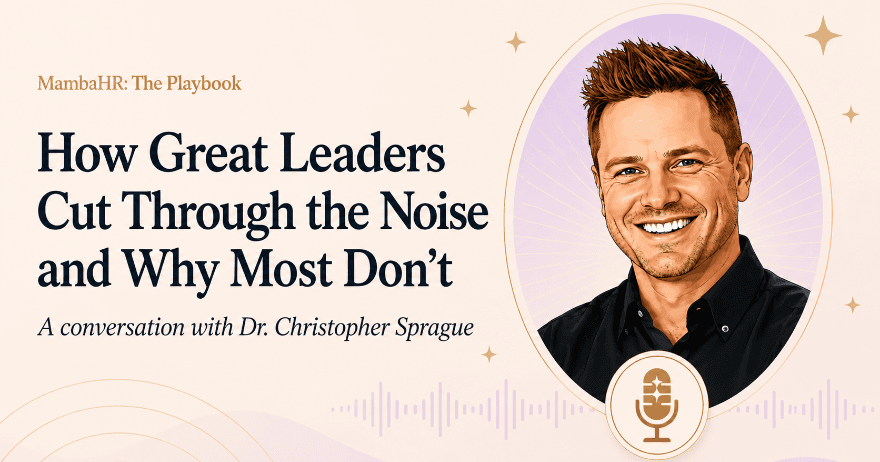
Watch the full conversation with Dr. Christopher Sprague on MambaHR: The Playbook.
Most leaders are drowning.
Slack notifications, urgent emails, back-to-back meetings, and the constant pressure to be "always on" has created a leadership crisis that nobody wants to talk about.
Dr. Christopher Sprague has spent over two decades helping Fortune 100 companies cut through this chaos. As the author of "Lead Without Limits" and co-founder of the Enluma Leadership Group , he's developed frameworks that help leaders focus on what actually moves the needle.
But here's what makes Chris different: he has a PhD in toxicology, not business. That unconventional path gave him insights about leadership that most traditional approaches miss entirely.
The Calculus Teacher Who Changed Everything
Chris told me a story that perfectly captures what real leadership looks like. In high school, he had a calculus teacher named Mr. Michael Ish who made students excited to go to math class every single day.
Not tolerate it. Not endure it. Actually excited.
Mr. Ish would call students by their last names, make witty comments that stuck with them decades later, and somehow taught them more than a full college semester of calculus while they were having fun doing it. Chris still talks about this teacher with friends from that class, thirty years later.
"That's how it should be," Chris told me. "We should be able to roll up our sleeves and enjoy what we're doing and create an environment where people can just kick butt."
This hit me because it's so rare. How many leaders create environments where people are genuinely excited to show up? Where the work is challenging but enjoyable? Where people are learning more than they thought possible without even realizing how hard they're working?
The First Management Lesson That Matters
Chris shared a story from his first leadership role that every manager needs to hear. He inherited two direct reports, including someone I'll call Barbara, who spent eight hours a day scanning safety data sheets into a computer system.
That's it.
For seven years.
In their first one-on-one, Chris said, "Barbara, I have to be honest with you. I don't know how you don't go insane."
Her response floored him: "You're the first manager who's ever done a one-on-one with me."
Seven years. Multiple managers. No one had ever taken the time to sit down with her and understand her as a person or explore what she might be capable of beyond scanning documents.
When Chris asked what she'd rather be doing, Barbara said she was interested in change management. He gave her some resources, asked her to spend two weeks developing a plan, and she came back with something better than he could have created himself.
The lesson isn't complicated, but it's profound: most people are capable of far more than their current role suggests. But they need someone to see that potential and give them a chance to show it.
The Enluma Model: What High-Performing Teams Actually Do
Chris and his team surveyed over 420 people with a simple question: Have you ever been part of a group where people happily worked hard and achieved incredible results? What made that possible?
Four consistent elements emerged, which became the Enluma leadership model:
Team First: A genuine "we before me" culture where people focus on collective achievement. Chris suggests a simple practice: one day a week, share information with a peer without them having to ask.
When you start doing this, others begin sharing information with you. It creates a positive cycle of collaboration.
Accelerate: High-performing teams constantly share information and ask questions. They don't hoard knowledge or wait to be asked. They proactively accelerate progress through communication.
Elevate: Understanding the challenges your peers face and helping them grow. This includes something most of us forget: recognizing our peers when they do great work. We remember to recognize our direct reports, but peer recognition is often overlooked.
Realize: Working toward something meaningful and regularly discussing significant goals. It's about making progress that helps others, not just hitting individual metrics.
What struck me about this framework is how practical it is. These aren't abstract leadership concepts. They're specific behaviors you can start implementing immediately.
The Post-Pandemic Leadership Challenge
Chris identified something I hadn't fully articulated but have definitely felt: we lost the time between meetings.
Before COVID, there were natural transition periods where you'd walk down the hall, grab water, have spontaneous conversations. Those moments built relationships and shared context.
Now, even when we're back in the office, we're scheduling back-to-back video calls because we need to "jump on the next call immediately." Chris has seen people in the same building having remote meetings because they don't have time to walk from one conference room to another.
"We're still basically remote even though we're at work," he observed.
This resonated deeply with me. The technology that was supposed to make us more efficient has eliminated the human moments that actually make teams work. Great leaders are being intentional about creating those connection points that used to happen naturally.
Why Cross-Team Collaboration Actually Matters
I asked Chris about something I've struggled with: how do you convince people that cross-team collaboration matters when they can just "do their job and go home"?
His answer reframed everything for me.
When people work well across teams, they start identifying opportunities that are bigger than any individual contribution. From a motivation perspective, they begin focusing on collective impact rather than just personal tasks.
But here's the kicker: when senior leaders don't collaborate well, they give permission for their entire organizations to create silos. If the head of operations and the head of commercial don't get along, their teams won't work together either.
Chris made a point that stopped me in my tracks: "Your competition is not internal, it is external."
Companies that create internal competition between regions or departments are actually encouraging mediocrity because teams won't share their best practices with each other.
The Art of Cutting Through Noise
With all the Slack channels, emails, texts, announcements, and SharePoint notifications we deal with daily, I asked Chris how leaders can stay focused on what actually matters.
His approach is elegantly simple: every Sunday night, he spends one hour (7-8pm) identifying his top five priorities for the week. When new requests come in, he can evaluate them against those established priorities.
"A lot of times they come back and say, 'Well, no, I just wanted to reach out because it was top of my head, but two weeks is fine,'" he told me.
The key insight is that most "urgent" requests aren't actually urgent. But without clear priorities, everything feels equally important, which means nothing is actually important.
The Metrics That Actually Matter
Chris shared three organizational health signals that every leader should watch.
First, attrition rates, specifically regrettable versus non-regrettable losses. He warned about leaders who justify every departure of good people. If a rockstar leaves and the manager says "it wasn't working out," that's a red flag. It usually means the leader isn't looking at themselves.
Second, engagement scores, which are standard but still important for identifying trends and patterns.
Third, environmental temperature checks. For in-person teams, what's the mood when you walk around? Do people engage with you? In all-employee meetings, is it just the leader talking, or do people feel comfortable asking questions?
"Great leaders, people are asking a boatload of questions because they're curious and they want to understand," Chris said.
The Power of Subtraction
One of my favorite insights from our conversation was about the power of removing things rather than adding them.
Chris shared an example where his team spent 3-4 hours every month creating performance reports. One month, they decided to skip sending them out to see if anyone would notice.
Nobody did.
The reports had been requested by a leader who had left the company years earlier, but the team kept creating them out of habit. By eliminating this one task, they freed up significant time that could be used for actual value-creating work.
This made me think about all the processes, meetings, and reports we continue doing simply because "that's how we've always done it." How much time and energy could we free up by questioning what we actually need to do versus what we think we need to do?
AI and the Future of Leadership Development
Chris is working on something fascinating: using AI to provide micro-level leadership coaching based on 360-degree feedback.
Instead of generic leadership advice, the AI coach would say something like, "I see you want to work on staff meeting effectiveness. When's your next meeting? Try these three things and let's talk afterwards."
What excites me about this approach is that it's focused on specific, immediate situations rather than abstract concepts. It's coaching that meets you where you are, when you need it, with actionable advice you can implement right away.
But Chris was clear that AI coaching only works when it's connected to real data and specific challenges.
"If you gave me an AI coach for the sake of an AI coach, I wouldn't use it," he said. "But if you do it with focused analytics where people have something they need to work on, then it becomes valuable."
What This Means for Your Leadership
The conversation with Chris reinforced something I've been thinking about: great leadership isn't about having all the answers or being the smartest person in the room.
It's about creating environments where other people can do their best work.
It's about taking the time to really see the people you work with. Not just their current role, but their potential.
It's about being intentional with your priorities so you can focus on what actually matters instead of just reacting to whatever screams loudest.
It's about understanding that your job as a leader isn't to be the hero of every story, but to help other people become heroes of their own stories.
Three Things You Can Do This Week
Based on my conversation with Chris, here are three specific actions you can take immediately.
Share information proactively: Pick one day this week and share something useful with a peer without them asking for it. See what happens.
Define your priorities: Spend one hour this weekend identifying your top five priorities for next week. When new requests come in, evaluate them against this list.
Ask better questions: In your next team meeting, focus on asking questions that help others think rather than just providing answers. Notice how the dynamic changes.
Great leadership isn't about perfection. It's about being intentional with how you show up and creating space for others to show up as their best selves too.
The question is: what is one way you can create more space for the people around you to show what they’re capable of?