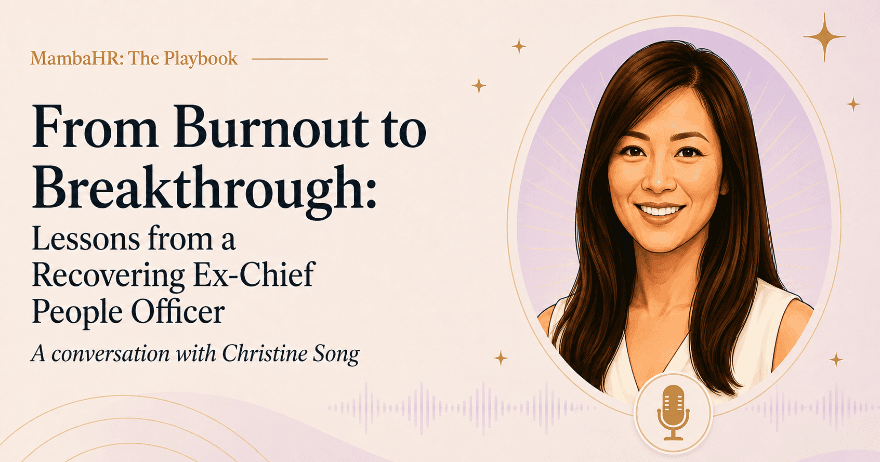
Watch the full conversation with Christine Song on MambaHR: The Playbook.
I just had one of those conversations that completely shifts how you think about HR leadership. My guest Christine Song introduced herself as a "recovering ex-Chief People Officer," and when I asked her to describe herself, her answer stopped me in my tracks: "I would describe Christine as an HR leader that always wore the CEO hat."
That's not something you hear every day in our profession. But as we dove deeper into her journey from English literature major to CHRO, I realized Christine had cracked a code that most HR professionals never discover: how to operate with true strategic ownership while building cultures that people actually want to be part of.
The Owner Mindset That Changes Everything
What struck me most about Christine's approach wasn't just her success, but how she got there. She didn't wait for permission to think strategically. She didn't wait for the title to start acting like a leader. From day one, she operated as if the company was her own.
"I spent every dollar as if it was off of my credit card," she told me. "Every hire I made, I made as if they were my direct hire, even if they were working in a different vertical, even if it was in sales or whatever. It was such a big decision for me because every mistake you make affects the company for years."
This isn't just about working harder. It's about fundamentally changing how you view your role. Christine grew up watching her parents run small businesses, working 16-hour days without vacation time, fighting for every dollar. That experience taught her that ownership isn't about equity. It's about mindset.
When you truly operate like an owner, everything changes. You stop thinking about your department and start thinking about the business. You stop focusing on HR metrics and start focusing on business outcomes. You stop waiting for direction and start identifying problems that need solving.
The Strategic Purview That Sets Leaders Apart
What fascinated me about Christine's perspective was her insight that "HR touches on all areas of a business holistically. The only other role that does that is the CEO's role." This is why she operated with what she calls "the CEO hat," because the scope of impact is remarkably similar.
Think about it: As HR leaders, we're involved in hiring decisions that shape every department. We're designing cultures that impact every employee interaction. We're building systems that affect how work gets done across the entire organization. We're managing costs, driving performance, and influencing strategic decisions at every level.
Yet too many of us get trapped in tactical execution instead of strategic thinking. We focus on compliance instead of competitive advantage. We manage processes instead of driving outcomes.
Christine's approach was different. She and her CEOs "almost ran the business like as if we were co-founders." That partnership mindset, where you're not just implementing decisions but actively shaping them, is what separates good HR professionals from great ones.
The Communication Superpower
One of the most practical insights from our conversation was about communication. Christine's background in English literature wasn't a detour from her HR career—it was the foundation of it. "Communication is so critical," she emphasized. "Every single one of us should be strong communicators. If you can communicate really well, you'll be able to sell things really well."
This resonates deeply with my own experience. In HR, we're constantly selling. Selling candidates on opportunities, selling employees on changes, selling leaders on investments in people. We're translating between different parts of the organization, explaining complex policies in simple terms, and building buy-in for initiatives that affect everyone.
But communication in HR goes beyond just being articulate. It's about being a truth-teller. Christine described herself as someone who speaks the truth and gets people focused on what matters most. She's not afraid to push back on executives, challenge the board, or call out inefficiencies because that's what owners do.
Building Cultures That Actually Work
One of the most powerful parts of our conversation was about culture building. Christine shared how she worked at companies where no one had heard of them yet. There were days when they weren't sure they were going to make payroll. These were hard environments to work in, but they didn't have a mass exodus of people leaving. In fact, people wanted to work even harder
How do you create that kind of commitment? It starts with treating people like co-founders, not just employees.
"When you treat people like they are co-founding members, they start acting like it as well," Christine explained.
But this isn't about ping-pong tables and free snacks. It's about creating genuine ownership and pride. Christine talked about how successful companies communicate their mission and values daily, not just at town halls, but in one-on-ones, team meetings, and casual conversations.
"It's almost cultish," she admitted, "but you've gotta talk about the values and the mission and you've gotta repeat it."
The key is authenticity. People can sense when leadership genuinely believes in what they're building versus when they're just going through the motions. When leaders demonstrate real commitment to the mission and treat every team member as a valuable contributor to that mission, it creates a flywheel effect where everyone starts operating at a higher level.
The Art of Strategic Pushback
Perhaps the most valuable skill Christine shared was how to push back effectively at senior levels. This is something every HR professional needs to master, but few do well. Her approach is rooted in choosing the right partners and being strategically direct.
"I'm gonna choose my CEO wisely because I am gonna be direct, I'm gonna be honest, and I'm not gonna sugarcoat the truth," she explained. "And so if I even see a hesitation in a CEO where I know they can't take feedback and they're not gonna be courageous, I know it's not gonna work out."
This is crucial advice for anyone in HR. You can't be effective if you're walking on eggshells around leadership. The best HR professionals are trusted advisors who can deliver difficult truths and challenge decisions when necessary. But that requires working with leaders who value that input.
When Christine does push back, it's always framed around business impact. "How's it going to impact our performance? Is this going to allow us to save more money? Will this allow our teams to move faster? Will this increase our velocity?"
She's not pushing back for the sake of it. She's advocating for changes that will improve business outcomes.
What Great Teams Actually Look Like
I asked Christine about the patterns she's seen in the best teams, and her answer was illuminating.
"Great teams communicated so well. They did things on behalf of the company. It was not something that was self-serving."
This distinction between good and great is crucial. Good teams perform well individually. Great teams sacrifice individual recognition for collective success. They ask "What's right for the company?" instead of "What makes me look good?"
Christine shared how she would challenge leaders by saying, "Don't think about yourself. What do you think would be the right thing to do for the company? I want you to think about that and then come back to me tomorrow."
Invariably, they knew the right answer—they just needed permission to act on it.
This creates a culture where people are genuinely aligned around shared success rather than competing for individual wins.
"When you do what's right for the company, the tide rises all boats," Christine noted. "Everyone sees you as the hero doing what's right for the company."
The Future of HR Leadership
What excites me most about conversations like this is seeing how HR leadership continues to evolve. Christine is now co-founding The Five Nine Society, an exclusive network for high-level executives that addresses the post-COVID decline in professional networking. She's also passionate about building AI-powered career pathing tools that could revolutionize how we approach professional development.
But beyond the tools and platforms, what Christine represents is a fundamental shift in how we think about HR's role in organizations. We're not just the people who handle benefits and compliance. We're strategic business partners who shape culture, drive performance, and create competitive advantages through people.
Your Next Steps
If Christine's insights resonate with you, here are some ways to start applying this thinking immediately:
• Start operating like an owner today. Look at every decision through the lens of "What would I do if this was my company?" Stop waiting for permission to think strategically about business problems.
• Develop your communication skills relentlessly. Whether it's writing, presenting, or having difficult conversations, your ability to communicate clearly and persuasively will determine your impact more than any technical HR knowledge.
• Learn something outside of HR this week. Christine's advice was simple but powerful: "Learn one thing outside of HR, whether it's sales, marketing, product service, but it's not HR." Understanding how other parts of the business work makes you a more effective strategic partner.
• Focus on people analytics, not just basic metrics. Christine called this HR's most underused superpower. Start digging deeper into data that actually drives business decisions, not just compliance reporting.
• Choose your leaders wisely. If you're in a role where you can't be honest and direct with leadership, you're limiting your potential impact. Seek out environments where truth-telling is valued and strategic thinking is encouraged.
• Build real relationships and trust. Christine emphasized that relationships matter more than resumes. Invest in building genuine connections with colleagues across the organization, not just within HR.
The Bottom Line
Christine's journey from English literature major to strategic HR leader proves that success in our field isn't about following a prescribed path. It's about adopting the right mindset and consistently delivering value.
When you operate like an owner, communicate like a leader, and focus on business outcomes instead of just HR activities, you become indispensable.
The companies that will thrive in the coming years are those that recognize HR as a strategic function, not just a support service. Leaders like Christine are showing us what that looks like in practice.
The question is: Are you ready to wear the CEO hat in your own role?