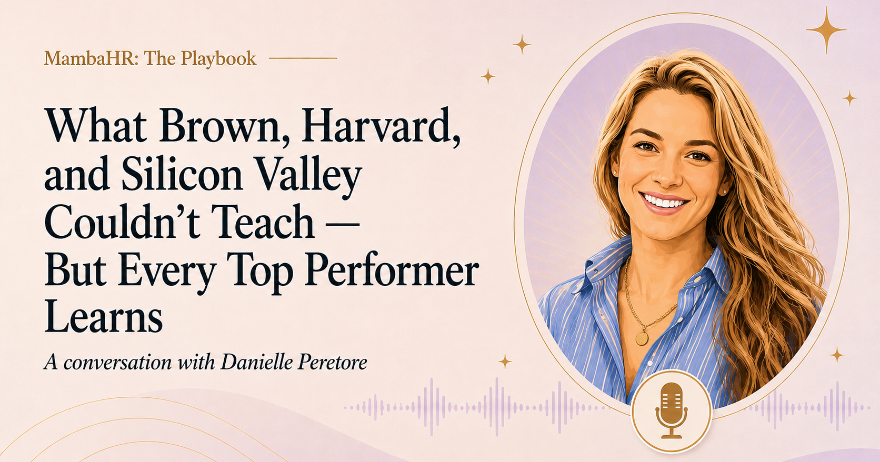
Watch the full conversation with Danielle Peretore on MambaHR: The Playbook.
I just had a conversation that completely shifted how I think about elite education, strategic leadership, and what actually matters for career success. My guest Danielle Peretore has the kind of resume that makes people assume she has all the answers: Brown undergrad, Harvard MBA, BCG, LinkedIn, and now leading strategy at Figma.
But what struck me most wasn't her impressive background. It was her willingness to admit what those prestigious institutions couldn't teach her, and how the most important lessons came from embracing vulnerability, following great people instead of prestigious companies, and never losing sight of the human element in business.
The Freedom to Think Differently
When I asked Danielle about her elite education, I expected to hear about networking and prestige. Instead, she talked about something much more valuable: the freedom to think differently. At Brown, she discovered an environment that said, "We trust you. We know that you are smart. We expect that you're going to grow and change."
This wasn't about following a prescribed path. It was about having the space to figure out who she really was. Danielle went in thinking she'd do biomedical engineering, attended exactly one class, and said "I'm out of here." She ended up with degrees in cognitive neuroscience and Portuguese and Brazilian studies. Not exactly a traditional business track, but it taught her something invaluable: how to think for herself.
"The only thing that actually links us all together is that in some way we are all a little bit different, like a little bit offbeat, like a little bit looking for what is the way that I want to do things, not necessarily the way that I'm told to do things," she explained about her Brown classmates.
This resonates deeply with my own experience. The professionals who truly stand out aren't the ones who follow the rulebook perfectly. They're the ones who question the rules and find better ways to solve problems.
The Power of Strategic Vulnerability
Perhaps the most counterintuitive insight from our conversation was about vulnerability in senior leadership. When Danielle joined Figma six months ago as their BizOps leader, she was moving from a decade in sales and go-to-market into the product development space, which was completely new territory for her.
Her approach? Get radically honest about what she didn't know.
"When you fail as a senior leader is when you choose to not become vulnerable. When you are not willing to say, I don't know this. Help me learn it," she told me. "Where you actually fail is when you're trying to hide that you don't know, and then just showing up to conversations not owning that."
This flies in the face of traditional leadership thinking, where admitting ignorance is seen as weakness. But Danielle's experience proves the opposite. By being upfront about her knowledge gaps, she was able to build relationships with key people across product, engineering, sales, and finance who became her teachers and allies.
The result? In just six months, she's built the intuition and understanding needed to drive strategy across the entire business. That's the power of strategic vulnerability. It accelerates learning and builds trust simultaneously.
The Art of Strategic Problem-Solving
One of the most practical insights from our conversation was Danielle's approach to strategic problem-solving. Having learned structured thinking at BCG, she's developed a methodology that combines top-down and bottom-up analysis to distinguish signal from noise.
"You have to collate across what your experience and your intuition and your past... You have to be able to put that together with what you are hearing," she explained.
But what you're hearing comes from two very different sources.
From executives, you'll get either high-level problems that need to be broken down into actionable components, or recency bias from their last conversation. From the front lines, the reps, managers, and customers, you'll get the real operational challenges and opportunities.
The magic happens when you can synthesize both perspectives. If something is bubbling up from both the top and bottom, that's your signal. If it's only coming from one direction, you need to dig deeper to understand why.
This approach has served Danielle throughout her career, from her early days at BCG to her current role building strategy at Figma. It's a framework any of us can apply, regardless of our level or industry.
AI and the Future of Human Work
Given Danielle's current role at Figma, I had to ask about AI. Her perspective was both practical and optimistic. At Figma, she spends 50-75% of her time thinking about AI, the market, product integration, customer adoption, pricing strategy.
But personally, she sees AI as an opportunity to become more human at work, not less.
"My sincere hope for the future of AI is less job replacement and more enabling us to spend time on the things that truly we can only do as humans that are relationship based," she said. "There would be very hard for me to point to anything in the world of business that does not boil down in some way to a relationship."
This perspective resonates with me deeply. Instead of fearing AI, we should be asking: What tasks can AI handle so I can focus more on coaching my team, building relationships, and solving complex human problems?
Danielle gave a perfect example: instead of spending hours manually compiling status reports from scattered sources, AI could handle that data aggregation, freeing her to spend those hours on coaching and development conversations with her team.
The Inner Child in Management
Perhaps the most profound insight from our conversation was Danielle's philosophy on management. As a mother of two toddlers who became a senior leader around the same time she became a parent, she's developed a unique perspective on what drives human behavior at work.
"In all of us and in anyone that you manage and in your literal children, there's an inner child that is driving actually a lot of what we... way more than is comfortable to admit," she explained.
This insight has shaped how she approaches leadership. Instead of just focusing on performance metrics and deliverables, she thinks about how to be "the adult in the room" for herself, her team, and her company. She recognizes that everyone, regardless of their title or experience, has emotional needs, insecurities, and desires for recognition and growth.
Her most important measure of success? The feedback from her direct reports.
"Having a strong relationship with your manager can make everything okay, even in the worst of environments. And having a poor relationship with your manager can make everything terrible, even in the best environments."
This is a powerful reminder for all of us in leadership roles. Technical skills and strategic thinking matter, but at the end of the day, our impact is measured by how we make people feel and whether we help them grow.
Getting Into the Room Where Strategy Happens
One of the most practical questions I asked was about getting invited into strategic conversations. For those not yet in senior roles, how do you get into the room where decisions are made?
Danielle's answer was twofold.
First, find a manager who sees it as their job to bring you into those rooms.
"I see it as my job to find a reason to bring people into the room, even if it's to talk for five minutes, or just to listen, because you can't imagine what those rooms are like... unless you're in those rooms."
Second, be the person who raises their hand for problems that aren't clearly anyone else's responsibility.
"You wanna be the person who's like, maybe not in my job description, but I know this is something that people care about and I'm gonna go figure it out."
This approach has been central to Danielle's career progression. She's never waited for permission to solve important problems. She's identified gaps and filled them, building goodwill and demonstrating value along the way.
Follow People, Not Companies
Perhaps the most career-changing insight from our conversation was Danielle's approach to job selection. Despite working at prestigious companies like LinkedIn, Glassdoor, and Figma, she's never chased company names.
"I have exclusively followed people and not pursued companies. That is how I built my entire career," she revealed. "The content of what you're working on matters so much less than the person you're doing it with."
This philosophy has led her to follow leaders from LinkedIn to NerdWallet, Glassdoor, Asana, and now Figma. Each move was about continuing to work with people who challenged her, invested in her growth, and created environments where she could do her best work.
This is a profound shift from how most people think about career progression. We're often focused on company prestige, salary bumps, or impressive titles. But Danielle's experience proves that the quality of your manager and the people you work with will have a far greater impact on your career trajectory than any company name on your resume.
The Data Literacy Imperative
When I asked about the one skill every future leader should prioritize, Danielle's answer was immediate: "Really understanding how to use data to still signal from noise."
In our information-rich world, the ability to cut through the noise and identify what actually matters is becoming the ultimate competitive advantage. This isn't just about being able to read spreadsheets. It's about understanding how to ask the right questions, identify meaningful patterns, and use data to drive decisions rather than just support predetermined conclusions.
This skill becomes even more critical as AI generates more data and analysis. The leaders who thrive will be those who can interpret AI-generated insights within the broader context of business strategy and human behavior.
Personal Reset and Fiction Reading
One of my favorite parts of our conversation was about Danielle's off-the-clock habits. Despite her strategic role, she has a firm policy of not reading business books or listening to business podcasts outside of work. Instead, she focuses on fiction reading and what she calls "nervous system reset."
"There's something about reading fiction that I think opens you to the broad diversity of human experiences and human emotions and brings a level of empathy and understanding into whatever you do in your day to day," she explained.
This isn't just about work-life balance. It's about building the empathy and emotional intelligence that makes someone an effective leader. Fiction exposes us to different perspectives, helps us understand human motivation, and reminds us that business is ultimately about people with complex inner lives.
The Wisdom of Mama Territory
I have to share one of my favorite quotes from the entire conversation, which came from Danielle's mother: "Just because someone throws you a football doesn't mean you have to catch it."
This simple metaphor captures something profound about feedback, criticism, and other people's opinions. Just because someone offers you their perspective doesn't mean you have to internalize it or let it define you. You get to decide what feedback to accept, how much weight to give it, and what to do with it.
This is particularly important for high achievers who tend to take every piece of criticism to heart. Learning to filter feedback and maintain your own sense of self is crucial for long-term success and mental health.
The Bottom Line
Danielle's journey from Brown to Harvard to BCG to leading strategy at Figma isn't just about accumulating prestigious experiences. It's about learning to think independently, embrace vulnerability, follow great people, and never lose sight of the human element in business.
The most successful leaders aren't those who have all the answers. They're those who ask the right questions, admit what they don't know, and create environments where others can do their best work.
They understand that strategy doesn't exist in a vacuum; it's about aligning people around shared goals and helping them grow in the process.
Whether you're early in your career or leading teams today, Danielle's insights offer a roadmap for building influence, driving impact, and staying human in an increasingly complex business world.
The question is: what is one way you can embrace more strategic vulnerability in your current role?